
Stop Reacting, Start Predicting: Automate Your Fiber Network Monitoring.
The G-Link FAMS fiber monitoring system combines OTDR-based Remote Test Units (RTUs) with centralized NMS-FAMS software to monitor configured fiber links 24/7. It detects and locates optical cable faults, analyzes long-term loss trends, and displays fiber resources and alarms through a GIS-based dashboard. SMS and email notifications help maintenance teams respond faster, identify potential fiber degradation earlier, and plan proactive maintenance.
Are Manual Inspections and Unexpected Downtime Hurting Your Operations?

Traditional fiber network maintenance is reactive, expensive, and inefficient. You might be facing:
- Slow Fault Response: It takes hours, or even days, to locate a fiber break, leading to costly service level agreement (SLA) penalties and unhappy customers.
- High Operational Costs: Constantly dispatching technicians and vehicles for routine manual testing is a significant drain on your budget and manpower.
- No Predictive Insight: You can’t see gradual signal degradation or predict potential failures, leaving you vulnerable to sudden, critical outages.
- Complex Troubleshooting: Distinguishing between an equipment failure and a cable fault is difficult, leading to wasted time and resources.
- Incomplete Data: Manual test results are often poorly managed, making it impossible to compare historical data and track long-term network health.
The Intelligent Solution: G-Link's FAMS Fiber Monitoring System
The G-Link Optical Cable Automatic Monitoring & Management System (FAMS) transforms your network maintenance from a reactive chore into a proactive, intelligent operation.
Our system acts as your network’s 24/7 watchtower, leveraging advanced OTDR technology to provide a complete, real-time view of your fiber infrastructure’s health. It automatically detects, locates, and reports issues, allowing your team to fix problems faster and manage resources smarter.
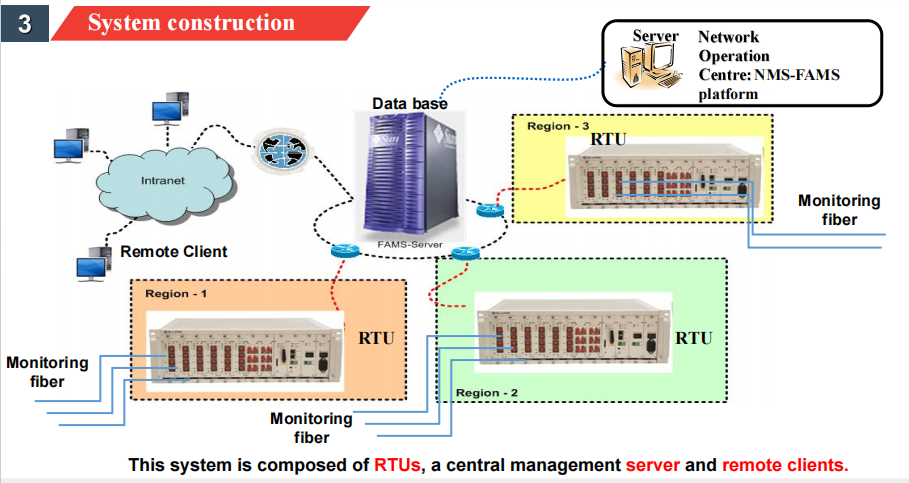
How It Works? A Smarter Workflow for a Healthier Network
1. Continuous Monitoring
Our Remote Test Units (RTUs) work with OTDR technology to monitor configured optical fiber links across your network. The system supports 24/7 online monitoring, periodic testing, and alarm-triggered testing, helping maintenance teams keep track of fiber conditions and identify faults more efficiently.
2. Intelligent Analysis
The centralized NMS-FAMS software platform collects optical monitoring data and manages network nodes, test results, and alarm events. Where the iAM analysis option is supported and licensed, intelligent link analysis can be used alongside historical loss trends and configured alarm thresholds to help identify potential fiber degradation and support proactive maintenance.
3. Instant Alerts & Action
When an optical fault is detected, the system displays fault information and helps maintenance teams identify the fault location through OTDR analysis and GIS-based resource management. Alerts can be delivered through SMS, email, and the monitoring platform, helping teams respond promptly and streamline troubleshooting.
Features & Benefits: From Advanced Features to Tangible Business Benefits
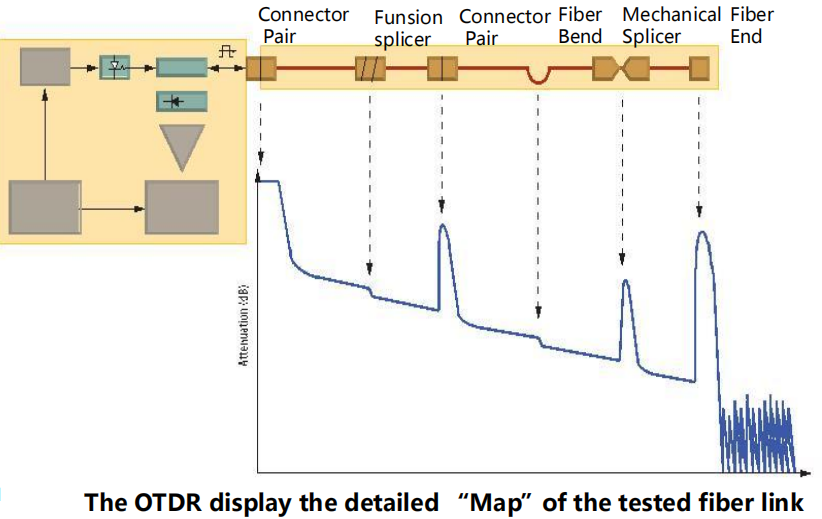
OTDR-Based Fault Detection and Loss Trend Analysis
The TMS400H uses OTDR technology to detect optical cable faults, measure fault distance, and help identify fault locations. It also supports long-term optical loss trend analysis, helping maintenance teams identify potential fiber aging and degradation earlier. For PON applications, the system can be integrated into the PON network architecture to monitor optical distribution network (ODN) links.
What this means for you: Improve fault localization efficiency, reduce reliance on manual OTDR testing, and help maintenance teams reach the relevant fault location more efficiently.
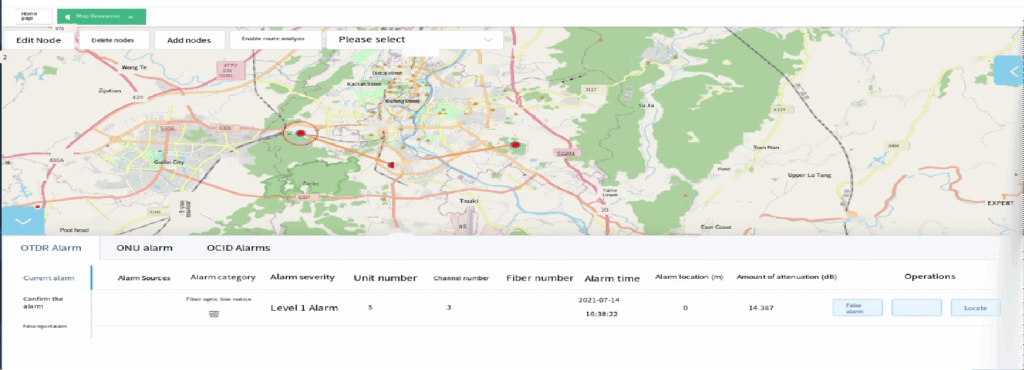
Visualize Your Fiber Network with GIS Mapping FAMS provides GIS-based visualization of registered optical fiber resources, including cable routes, manholes, optical distribution frames, and fiber splice locations. Maintenance teams can search and manage cable records, view monitoring information and alarm locations, and use network topology and historical data to support maintenance planning.
- What this means for you: Easily manage cable resources, access asset information, and improve maintenance dispatch planning.
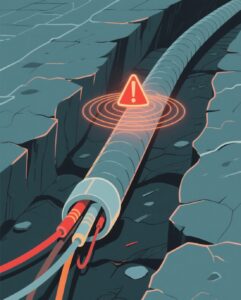
Optical Vibration Monitoring For supported configurations, G-Link’s optical cable monitoring solution can analyze vibration responses along monitored fiber links and trigger configured alarms. This capability can support the monitoring of abnormal disturbances along optical cable routes. Detection scenarios, localization performance, and applicable hardware configurations should be evaluated for each project.
- What this means for you: Gain additional visibility into potential disturbances along monitored cable routes and support more proactive infrastructure maintenance.
Real-Time Alarms and Historical Reports When a monitored optical fault is detected, FAMS displays the alarm information and helps maintenance teams identify its location through OTDR analysis and GIS-based resource management. The system supports configurable alarm levels, SMS and email notifications, historical alarm records, monitoring data queries, and statistical reports to assist troubleshooting and maintenance planning.
- What this means for you: Focus on critical alerts, eliminate noise, and improve access control through role-based user permissions.

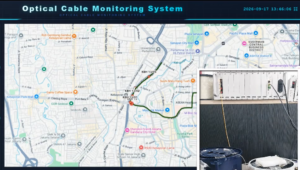
Track Optical Loss Trends for Proactive Maintenance G-Link FAMS records and analyzes optical fiber test data over time, helping maintenance teams track total link loss, attenuation changes, and event locations. By comparing current measurements with historical records, the system helps identify potential fiber degradation and supports more informed maintenance planning.
- What this means for you: Gain better visibility into long-term fiber performance and identify potential issues before they develop into more serious faults.
Flexible Deployment for Centralized Fiber Network Management
G-Link FAMS uses a browser-based management architecture that connects remote optical fiber monitoring units to a centralized management server. Depending on project requirements, the platform can be deployed on-premises or in a cloud environment, allowing authorized users to access fiber monitoring data, resource information, and alarms through a web interface.
The deployment architecture can be tailored to the customer’s network structure, monitoring scale, and IT requirements.
What Is Included in a G-Link FAMS Deployment?
A typical G-Link FAMS solution consists of remote optical fiber monitoring units with OTDR modules, centralized network management software, and a local or cloud-based server environment. The final configuration depends on the number of fiber links to be monitored, required monitoring ports, network connectivity, software deployment preferences, and integration requirements.
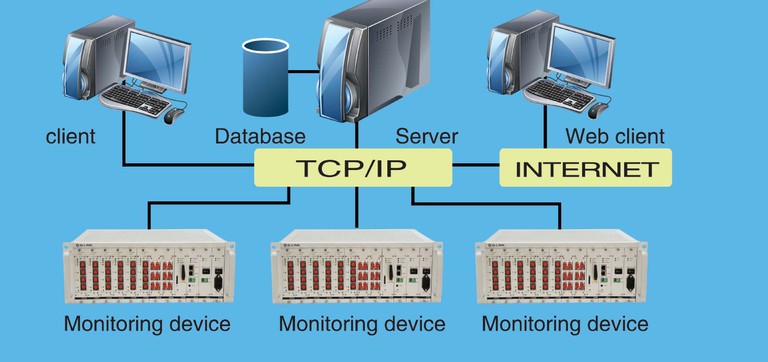
G-Link FAMS: Integrated Fiber Monitoring Capabilities
Compared to outdated monitoring schemes that piece together separate devices, the G-Link FAMS is a fully integrated, more efficient, and more reliable system.
For a full walkthrough of deployment, fault detection, and ROI, see our fiber monitoring guide.
| Feature | G-Link FAMS / TMS400 Series | Conventional Monitoring Architectures |
|---|---|---|
| Monitoring Architecture | Single-ended OTDR monitoring in supported configurations | May require separate optical power monitoring, switching, or far-end light sources, depending on system design |
| System Integration | Integrated optical monitoring and centralized management platform | May use multiple separate monitoring components |
| Rack Space | Modular rack-mounted design with configurable channel capacity | Rack space depends on the number and type of monitoring components |
| Scalability | Modular configuration with channel capacity tailored to project requirements | Expansion requirements depend on the system architecture |
| Fault Analysis | OTDR trace analysis, fault distance measurement, and optical loss trend analysis | Capabilities depend on the selected monitoring solution |
Tropical Climate Ready: Engineered to withstand high humidity (≤95% non-condensing) and robust surge/lightning protection, ensuring stable 24/7 performance in harsh Southeast Asian environments.
Applications: Built for Your Industry's Demands
The G-Link FAMS platform is a field-proven solution trusted by leaders in various sectors:
- Telecommunications Operators: For large-scale FTTx and backbone network monitoring.
- Data Centers: Monitor critical optical interconnects and help identify fiber faults before they cause prolonged service interruptions.
- Power Utilities: Monitoring fiber optic lines along power grids.
- Oil & Gas Pipelines: Protecting critical infrastructure from external threats.
- Transportation & Railways: Ensuring communication and signaling integrity.
- Government & Enterprise: Managing complex and secure communication networks.
Tired of Costly Downtime and Manual Inspections?
See the G-Link FAMS in action. Our experts can walk you through a personalized demo and show you how our system can integrate with your existing infrastructure to cut costs and boost efficiency.