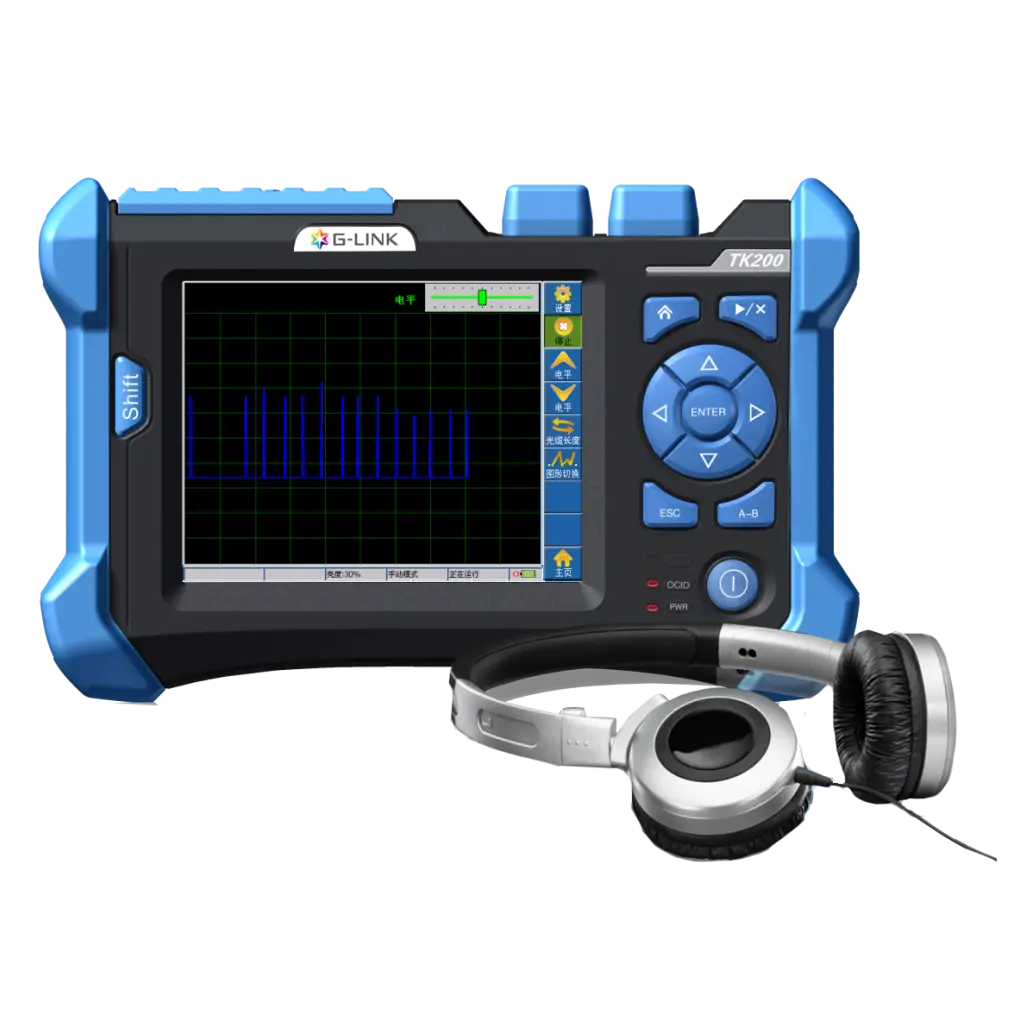
Solving the “Haystack” Problem in Fiber Maintenance In complex fiber networks—whether in crowded manholes, tunnels, or overhead pipelines—identifying one specific cable among dozens is a high-risk challenge. Traditional methods like cutting or bending can disrupt service. The G-Link TK200 Optical Cable Identifier is engineered to solve this precise problem. It is an essential tool for telecom engineers conducting resource census, cable cutovers, and emergency repairs.
How It Works (Interference Principle) The TK200 Optical Cable Identifier utilizes the photoelastic effect and optical interference. When a technician gently knocks on the target cable at the remote site, the instrument detects the specific mechanical vibration signal. It converts this into intuitive audio and visual signals (Waveform/ECG) on the screen. This allows the engineer at the central office to positively identify the target cable from up to 100km away with zero risk to active data transmission.
Built for the Real World Unlike basic identifiers, the TK200 excels in difficult scenarios. It requires only single-ended access and performs reliably even if the far end of the fiber is broken or terminated with APC connectors. With its rugged design and simple “knock-and-identify” workflow, it drastically reduces maintenance time and operational costs.
| Parameter | TK200-40/N (Standard) | TK200-100/N (Long Haul) |
|---|---|---|
| Test Distance | 40 km | 100 km |
| One-way Loss | 10 dB | 20 dB |
| Wavelength | 1550 nm | 1550 nm |
| Blind Zone | No Blind Zone | No Blind Zone |
| End Reflection | < 40 dB | < 20 dB |
| Display | 5.6-inch Touch Screen | 5.6-inch Touch Screen |
| Output Mode | Visual (Bar/ECG) + Audio | Visual (Bar/ECG) + Audio |
| Connector | FC/APC (Interchangeable) | FC/APC (Interchangeable) |
| Battery Life | ≥ 10 Hours | ≥ 10 Hours |
| Dimensions/Weight | 65 x 150 x 235 mm / 1.5kg | 65 x 150 x 235 mm / 1.5kg |
Cable Cutover & Relocation: Identifying the correct cable before cutting to prevent accidental service interruption.
Resource Census: Verifying and tagging cables in messy manholes or shared pipelines.
Troubleshooting: Locating specific cables in tunnels, direct-buried trenches, or overhead poles.
Dark Fiber Identification: Distinguishing between unused and active fibers without intrusion.
A. Select Your Model:
| Model Code | Max Distance | Application Scope |
|---|---|---|
| TK200-40/N | 40 km | Metro / Access Networks |
| TK200-100/N | 100 km | Backbone / Long Haul |
B. Standard Package (What's in the Box):
| Item | Qty | Note |
|---|---|---|
| TK200 Main Unit | 1 | With Battery & Stylus |
| AC/DC Adapter | 1 | 12V/3A |
| FC/UPC-FC/APC Patch Cord | 1 | Critical for connection |
| Audio Headset | 1 | For audio monitoring |
| Knocking Tool | 1 | Specialized percussion rod |
| FC Flange (Coupler) | 1 | |
| Carrying Bag | 1 | Soft case with strap |
| User Manual | 1 | Includes Calibration Cert |
Frequently Asked Questions (FAQ)
The TK200 Optical Cable Identifier uses the principle of optical interference. Instead of bending the fiber (which causes loss) or freezing it, it detects the phase change of light caused by gentle mechanical vibrations (knocking) on the cable's outer sheath. This method is completely safe for the fiber core.
Yes, it can. As long as the break point provides sufficient reflection (or if the break is far enough), the instrument can still detect the knocking vibration on the section before the break. For best results on broken fibers, we recommend selecting the TK200-100/N model for higher sensitivity.
The TK200 uses coherent detection technology which is very sensitive to reflections. The FC/APC (Angled Physical Contact) connector minimizes back-reflection at the instrument interface, ensuring a high Signal-to-Noise Ratio (SNR) for accurate long-distance detection. A dedicated patch cord is included in the package.
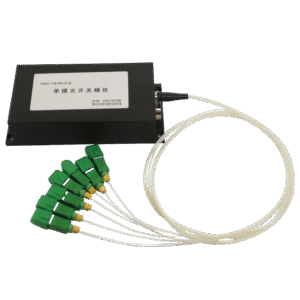
![High-density G-Link 1x128 MEMS Optical Switch module [cite 21] with multi-channel fiber optic fan-out](https://glinkotdr.com/wp-content/uploads/2025/11/High-density-G-Link-1x128-MEMS-Optical-Switch-module-cite-21-with-multi-channel-fiber-optic-fan-out-300x300.png)