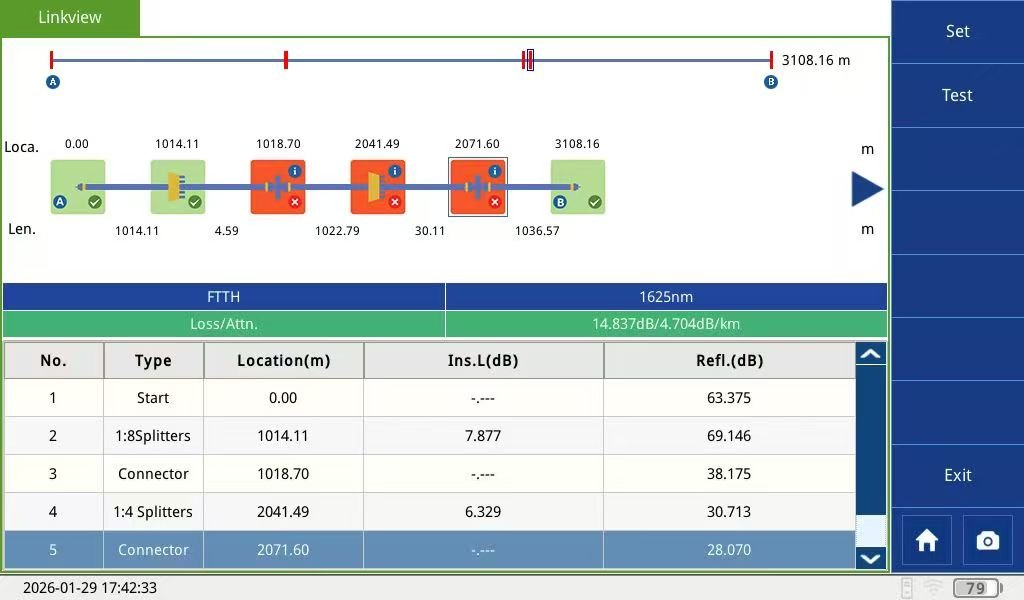
Lit fiber monitoring (also known as online monitoring) is a high-availability testing method used to scan active optical fibers while they are carrying live traffic. By utilizing a 1625nm or 1650nm wavelength—which falls outside the standard C-band and L-band data frequencies—and integrating Wavelength Division Multiplexing (WDM), network operators can perform real-time OTDR scans to detect faults without causing any service disruption or packet loss.
Table of Contents
The Critical Need for Non-Intrusive Testing
In today’s hyper-connected world of FTTH, 5G, and Data Center Interconnects (DCI), downtime is the enemy of revenue. Traditional fiber testing required taking the line out of service, a practice that violates modern Service Level Agreements (SLAs). This is why lit fiber monitoring has become an essential strategy for Tier-1 carriers globally.
At G-Link Technology, we’ve spent decades perfecting the balance between high-power test pulses and sensitive data signals.
1. The Science of Wavelength Isolation: 1625nm vs. 1650nm
To achieve successful lit fiber monitoring, you must use a “maintenance wavelength” that doesn’t interfere with the 1310nm, 1490nm, or 1550nm communication bands.
According to the ITU-T L.41 standard, the 1625nm and 1650nm bands are specifically reserved for maintenance. These longer wavelengths offer a secondary advantage: they are much more sensitive to macro-bending. This means lit fiber monitoring can detect a cable that is being pinched or stressed by construction before the fiber actually snaps.
2. Technical Comparison: Lit vs. Dark Fiber Monitoring
Many operators ask whether they should monitor “dark” (unused) fibers or “lit” (active) fibers. The following table highlights the key differences:
| Comparison Metric | Dark Fiber Monitoring | Lit Fiber Monitoring (Online) |
| Wavelength Used | Usually 1550nm | 1625nm or 1650nm |
| Hardware Complexity | Low (Standard OTDR) | Medium (OTDR + WDM Filters) |
| Service Disruption | None (Fibers are idle) | None (Non-intrusive) |
| Detection Accuracy | High | Highest (Tests the actual traffic path) |
| Operational Value | Basic health check | Real-time SLA protection |
| Typical Scenario | New cable deployment | 5G Backhaul, FTTH, DCI links |
3. Implementing WDM as the “Traffic Combiner”
The heart of lit fiber monitoring is the WDM (Wavelength Division Multiplexer). In G-Link’s TMS400 system, we use high-isolation WDM filters to merge and separate light.
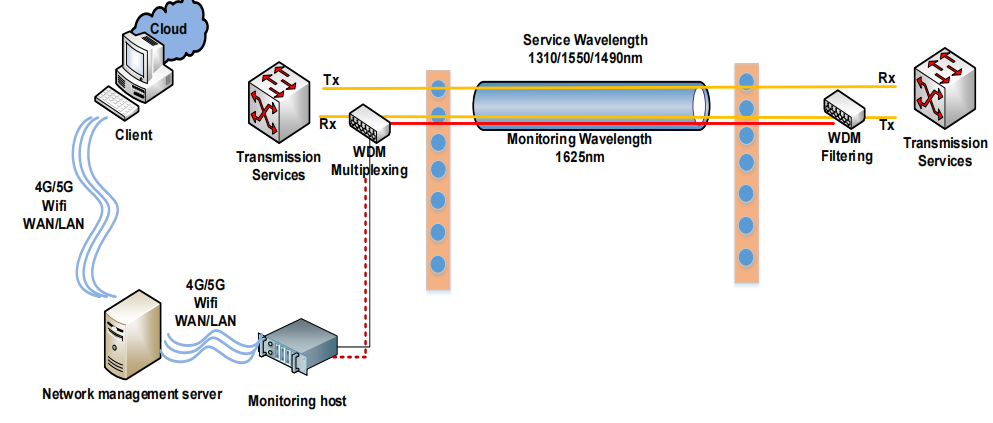
- Injection: The RTU (Remote Test Unit) injects a 1625nm pulse into the fiber.
- Coexistence: The WDM board ensures the test signal travels alongside the 1550nm business data without crossing paths.
- Protection: On the receiver end, the WDM filter blocks the 1625nm test light from reaching the sensitive OLT/ONT transceivers, preventing “receiver blinding.”
4. Hardware Excellence: G-Link RTU Specifications
For high-capacity networks, the hardware must be robust. Below are the technical specifications for our lit fiber monitoring modules, as detailed in our 2025 FAMS Solution guide:
| Feature | Specification Details |
| Wavelength Accuracy | 1625nm ± 20nm / 1650nm ± 20nm |
| Dynamic Range | 38dB / 40dB / 45dB (High Dynamic) |
| Event Dead Zone | < 0.8 meters |
| Attenuation Dead Zone | < 4.0 meters |
| Channel Capacity | Up to 144 channels per 4U Chassis |
| Network Topology | Support for P2P and P2MP (PON) |
5. Converting Data into ROI: Proactive vs. Reactive
The financial impact of lit fiber monitoring is most visible in the reduction of “Truck Rolls” (field technician dispatches). By identifying attenuation spikes early, operators can schedule repairs during normal working hours rather than paying for emergency midnight call-outs.
Key Benefits of G-Link’s Lit Fiber Monitoring:
- 99.9% Service Continuity: Test during peak hours without risk.
- Accurate Fault Localization: Pinpoint breaks to within ±10 meters.
- Advanced Deterioration Detection: Catch moisture ingress or chemical contamination early.
Conclusion: Securing Your Network’s Future
Lit fiber monitoring is no longer a luxury for premium links; it is the foundation of a resilient, automated fiber plant. By leveraging CETC 34th Institute technology, G-Link provides the precision and reliability needed to protect your mission-critical data.
Ready to upgrade your maintenance strategy?[Contact our Engineering Team] for a custom lit fiber monitoring topology design.